A Wedding Invitation, Read for Dress-Code Clues
Read wedding invitation dress-code clues in the wording, schedule and venue to understand what the hosts expect without treating every detail as a rule.
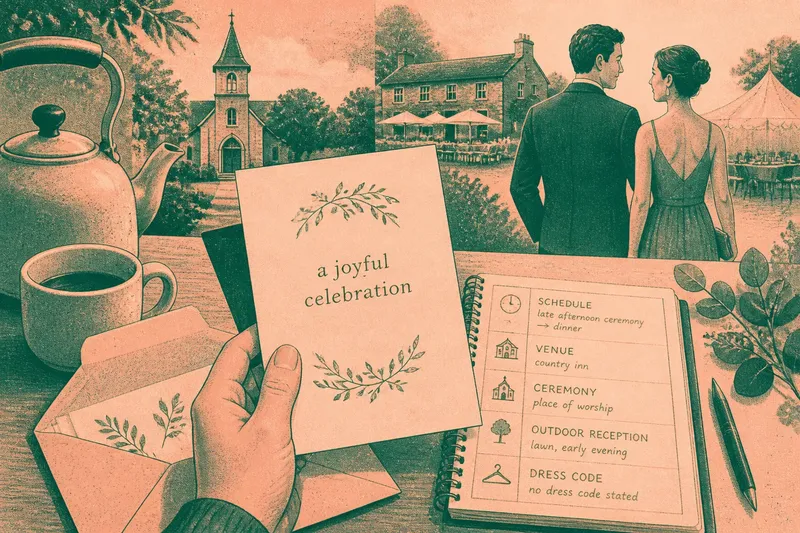
The envelope is open beside the kettle, and the invitation says only “a joyful celebration”. Wedding invitation dress-code clues may sit in the schedule, venue details and practical notes rather than in a formal label. Read those signals as evidence of the hosts’ expectations, not as a code that demands elaborate decoding.
Start with direct requests
Look first for an explicit dress code or clothing request. “Black tie” is a direct instruction; “summer celebration” gives a tone but leaves room for interpretation. If the invitation names a colour, asks guests to cover their shoulders, or specifies a cultural or religious custom, treat that request more seriously than a decorative motif.
Words such as “formal”, “festive” and “relaxed” are less exact. They describe the intended atmosphere, so read them alongside the ceremony, reception and venue. A phrase such as “garden party” does not, by itself, mean that every guest should wear florals or a hat.
Read the schedule
The timing and order of events help clarify the expected level of formality. A morning ceremony followed by a daytime reception may suggest a different register from vows followed by a late dinner, but neither schedule fixes a particular outfit.
Notice whether the invitation lists separate locations or a change of scene, such as a registry office followed by dinner at a restaurant. This can signal that guests need clothes suitable for both parts of the day, rather than a complete change between them. The schedule is a useful clue to the event’s rhythm, not a dress code in disguise.
Use the venue carefully
A country house, hotel ballroom, place of worship or beach reception tells you something about the surroundings, but not everything about the hosts’ preferences. Check the venue’s own guest guidance if the invitation points to it, especially where a religious setting has specific expectations for clothing.
Separate practical conditions from assumptions about appearance. A lawn may make narrow heels awkward; a windy coastal site may call for a secure layer. Those details help you choose what will work on the day, but they do not establish that a particular colour, hemline or silhouette is required.
Weigh the invitation clues
When the wording is vague, give the strongest weight to direct requests, then consider the schedule and venue. Treat theme references and decorative details as softer clues unless the hosts say guests should dress to them.
- Observation: the invitation names a dress code. If it is explicit, follow its level of formality; if it is descriptive rather than specific, use the schedule and venue to interpret it.
- Observation: the invitation lists a religious ceremony. If it mentions clothing guidance, follow that guidance; if not, check the venue’s public visitor information or ask the organiser.
- Observation: the ceremony and reception are at different locations. If the gap is short, choose clothing suitable for both; if there is a substantial interval, check whether the invitation suggests a change of setting or dress.
- Observation: the reception is outdoors. If the ground is uneven or exposed, favour practical footwear and a layer; if it is a sheltered, formal reception, let the stated dress code take priority.
- Observation: the invitation mentions a colour or theme. If guests are directly asked to take part, follow the request where possible; if it appears only in the design or wording, treat it as atmosphere rather than a uniform.
- Observation: the event continues into dinner. If the invitation calls for formality, choose an outfit that remains appropriate in the evening; if it is silent, use the venue and the hosts’ wording rather than assuming evening dress is required.
- Observation: the dress code remains unclear after these checks. If a practical choice depends on the answer, ask the couple or organiser a brief question; if it does not, select the more polished of the plausible options.
Ask when needed
A short, practical question is better than asking the couple to approve a full outfit. “Would a suit be suitable for the reception?” or “Does the ceremony venue have any clothing guidance?” gives the organiser a clear point to answer.
Say you have an invitation to a late-afternoon ceremony at a country inn, followed by dinner, with no dress code. Your starting information is the time, the two-part schedule, the venue and the absence of a direct clothing request. You check the inn’s guest information and find no ceremony-specific guidance, then ask the organiser whether the reception is formal; the reply is that guests should dress smartly, without formalwear. The resulting choice could be a dark green midi dress with a jacket, or a navy suit with an open collar. Either respects the stated level of formality, while leaving room for personal preference.
Questions about invitations?
What does “smart casual” mean on a wedding invitation?
It usually points to tidy, intentional clothing rather than business formalwear or everyday leisurewear. Use the venue and schedule to decide how polished the outfit should be, since the phrase does not specify one fixed combination.
Does a wedding theme tell guests what to wear?
Only if the hosts ask guests to dress for it or state a clear clothing request. A colour palette or decorative motif can simply belong to the invitation and event styling.
Should I follow a venue’s clothing guidance?
If the ceremony takes place in a venue with its own guest guidance, check and follow the relevant instructions. If the guidance is unclear or seems to conflict with the invitation, ask the organiser rather than guessing.
Who should I ask about an unclear dress code?
Ask the couple or the person organising the event, keeping the question brief and specific. If the uncertainty concerns venue rules, check the venue’s own information as well.
Read without overreading
An invitation gives you the hosts’ clearest available signals, but not every detail carries equal weight. Direct instructions matter most; schedule and setting help interpret them; decorative language is usually the least binding.
For wedding invitation dress-code clues, the useful distinction is between a request and a hint. Treat the former as guidance to follow and the latter as context, then make a choice that fits the occasion without turning the invitation into a puzzle with one hidden answer.