When the Pocket Left the Seam
Trace how pockets evolved from separate waist pouches to sewn-in and visible forms, and see what their construction reveals about a garment’s intended use.
In a seventeenth-century gown, a hand could disappear through a slit in the skirt and reach a pouch tied beneath it. That arrangement was different from the sewn-in pocket familiar from later coats and trousers: the storage sat apart from the garment, though the garment provided access. The history of pockets is not a simple march from hidden to visible; distinct forms coexisted and suited different clothes.
Separate waist pouches
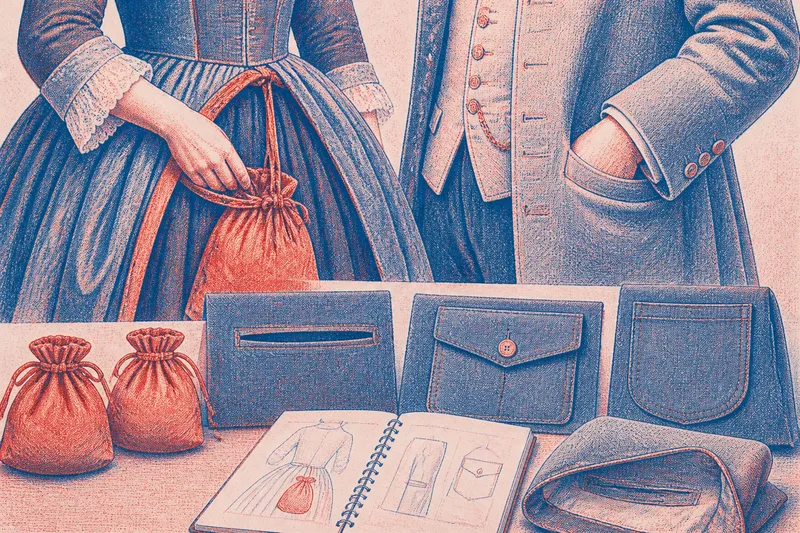
In Europe, surviving examples and depictions from the seventeenth and eighteenth centuries show separate pockets worn in pairs, tied around the waist beneath skirts or other outer garments. They were bags with their own ties, not pockets built into the garment. Openings in the clothing let the wearer reach them while keeping the pouches largely concealed.
This arrangement could provide storage without adding a pouch to the garment’s outer surface. It also depended on the shape and layers of the clothes: a fitted outfit without access slits, for instance, could make a tied pocket difficult to reach. Separate pouches remained useful alongside pockets sewn into garments rather than simply vanishing when tailoring changed.
Sewn-in construction
A sewn-in pocket attaches to the garment, often at a seam or inside its lining. In a seam pocket, the opening follows part of a joining seam and the pocket bag sits behind the outer cloth. A welt pocket frames an opening with narrow strips of fabric; a flap can cover it. These forms rely on different construction, but all make the pocket part of the garment itself.
Such pockets feature in tailored clothing, including coats and waistcoats, while patch pockets sit on the garment’s surface. Their use varied by garment and period, so there was no single moment when one construction replaced another. A pocket’s location could be chosen to preserve a smooth front, to make access convenient, or to serve a garment’s practical purpose.
Outer pockets and their signals
A patch pocket is attached to the outside, making its outline, stitching and position visible. On a work jacket, it can suit the garment’s practical character; on a shirt or casual jacket, a similar shape may read as informal. The effect depends on the garment and its setting, not on the patch pocket alone.
Tailored garments also use visible forms, including flap pockets and welt pockets. Their presence does not establish how much they can carry: the pocket bag may be shallow, and heavier contents can pull at the opening or alter the garment’s line. A pocket is rather like a drawer: its front tells you where to look, but not how much room is behind it.
What can pocket construction tell you?
How do separate pockets differ from sewn-in pockets?
A separate pocket has its own pouch and ties around the waist; access may be through an opening in the outer garment. A sewn-in pocket is attached to the garment, so its bag and opening are built into its construction.
What is the difference between a patch and a welt pocket?
A patch pocket is sewn onto the garment’s outer surface, while a welt pocket is made through an opening framed with strips of fabric. A flap may cover either a welt opening or another pocket form, so the flap alone does not identify the construction.
Why might a pocket be sewn shut?
A pocket opening may be temporarily stitched closed to help a garment keep its shape during handling or display. Check whether the bag is present and whether the stitches are intended to be removed before cutting; if uncertain, ask a tailor or the maker rather than opening it blindly.
How can you tell whether a pocket will suit daily use?
Check the bag’s depth, the opening’s width and the pocket’s position, then try reaching into it while standing and sitting. If the opening strains or the contents distort the cloth, reserve it for lighter items or use another pocket.
A pocket inspection
Before relying on a garment pocket, check each feature and let the result guide your choice:
- Opening: Observe whether it is a slit, welt, flap or patch, and whether your hand enters without stretching the cloth. If access feels easy, use it for suitable items; if the edge strains, choose another pocket.
- Pocket bag: Feel for the bag’s depth and fabric. If it holds your intended item without bulging, use it; if it is shallow or flimsy, keep contents flat and light or carry them elsewhere.
- Position: Reach into the pocket while standing and sitting. If your hand finds it comfortably in both positions, it may suit regular use; if the angle is awkward, use another pocket or treat this one as occasional storage.
- Reinforcement: Inspect the opening ends for secure stitching or bar tacks. If the edges appear sound, use the pocket for modest loads; if threads are loose or the cloth is stressed, avoid carrying weight and seek repair if needed.
- Effect on shape: Put in the object you intend to carry and check the garment from the front and side. If the cloth hangs smoothly, the pocket suits that object; if it tents or drags, remove the object or choose another carrying place.
- Closure: Check for a button, flap or zip and whether it closes over the intended contents. If it fastens securely, use it for items suited to that pocket; if it will not close, keep valuable or loose items elsewhere.
Putting the fit to use
Say you own a lightweight jacket with a narrow welt and a pocket bag that holds a flat card case but not a bulky phone. You try the phone while standing and see the front pull; sitting makes the opening gape. The card case leaves the fabric smooth in both positions, so the practical choice is to keep the welt for flat items and carry the phone elsewhere. That decision follows from the actual fit, not from the pocket’s polished appearance.
Pockets were never only openings in cloth: their construction also reflects how a particular garment makes storage available. For a useful reading of pocket history, the main search phrase is history of pockets; compare the bag, access point and position rather than assuming that a visible outline tells the whole story.