The Bias Cut, Explained Through the Grain of the Cloth
The bias cut changes how fabric hangs and moves. See how grain direction shapes a simple garment, from cloth layout to drape and fitting choices.
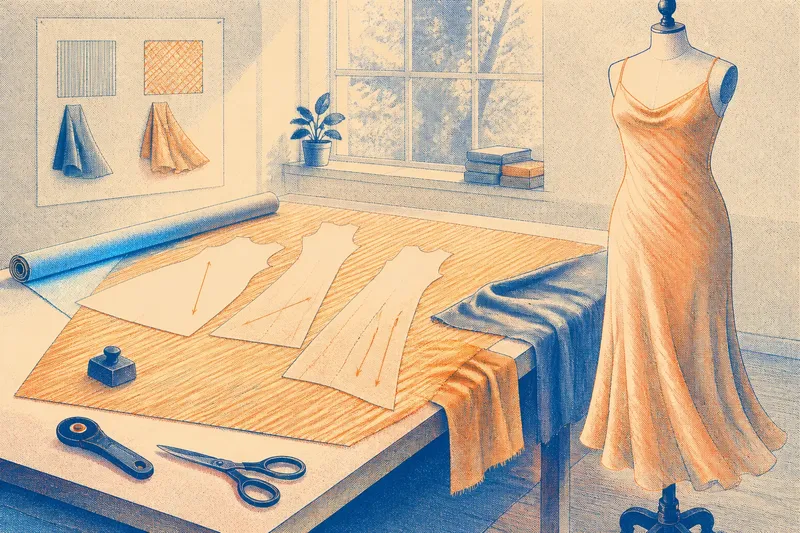
At a cutting table, a length of cotton lies square, its threads running neatly from selvedge to selvedge and from top to bottom. Turn the pattern piece a quarter-turn, and the same cloth begins to behave differently: its edges stretch more readily, and a curve can fall into a soft fold. That change is the point of the bias cut.
Bias cutting means placing a garment piece diagonally across the fabric’s grain, rather than aligning its main length with the lengthwise or crosswise threads. The grain is not a printed grid; it is the woven structure itself, and the direction of a piece affects how it hangs. A simple comparison makes the distinction clear: a straight-grain rectangle tends to hold its shape, while the same rectangle cut on the bias can lengthen and settle around the body.
Reading the grain
Woven cloth is made from two thread systems. The warp runs along the fabric’s length, usually parallel to the selvedges; the weft crosses it from edge to edge. Their intersections give the cloth much of its stability, though the amount of give varies with fibre, weave, finish and handling.
The bias lies diagonally between warp and weft. It is not a third set of threads. Rather, the woven grid can shift slightly along that diagonal, allowing a bias-cut piece to yield and drape more than a piece aligned with either main grain direction.
In dressmaking, “true bias” commonly refers to a diagonal set at roughly forty-five degrees to the warp and weft. A pattern’s grainline arrow indicates how to position a piece; when it runs diagonally across the cloth, that piece is being cut on the bias. The cloth’s actual response still depends on its construction, so the angle alone does not predict every result.
A square and a curve
Imagine two identical, plain-woven fabric rectangles, each marked with a shallow curved line. One is cut with its long edge parallel to the selvedge; the other is placed diagonally. If both are lifted by one end, the straight-grain rectangle is more likely to keep a firm, rectangular outline. The bias rectangle can stretch along its diagonal and fall into a softer, more fluid shape.
This is a comparison of tendencies, not a promise that every fabric will behave identically. A crisp cotton poplin, a loose crepe and a slippery satin will respond differently, even when their pattern pieces share the same orientation. The useful distinction is that grain direction influences how readily a shape yields under its own weight and with movement.
Think of a woven tea towel: pull it from opposite corners and its square can skew without any thread needing to break. Bias-cut cloth makes practical use of that small movement. The analogy stops there, since a garment also has seams, edges, body weight and repeated wear to contend with.
One dress, from layout to wear
Say you are making a simple sleeveless dress from a fluid woven fabric. The pattern has a gently shaped front and back, with shoulder seams and side seams; its instructions mark the body pieces for bias placement. You have a length of cloth, a large cutting surface and a pattern that can be laid out without folding the fabric tightly.
Before cutting, you identify the selvedges and check which direction the pattern marks as its grainline. You place the dress pieces diagonally across the cloth, keeping the intended angle consistent between the front and back. The shapes now use more fabric width than they would on straight grain, and the layout may leave larger offcuts. That is a real design and material trade-off, not an error in the pattern.
After cutting, the pieces feel more yielding along their edges. You handle them gently, avoid pulling one side to make it match the other, and follow the pattern’s order for assembling the seams. If a piece hangs for a while before hemming, a section may settle or lengthen more than its neighbour; the hem can then be checked and evened once the fabric has relaxed. The expected observable result is a dress whose body follows the figure with a softer fall than a comparable straight-grain version.
In this invented situation, the benefit is not simply “more stretch”. The bias lets the fabric accommodate curves and movement without relying only on darts or a rigidly shaped pattern. The cost is greater sensitivity during cutting, sewing and hanging: a small difference in handling can show up as an uneven edge or a seam that seems to ripple.
Where the shape changes
A straight-grain skirt panel often hangs with a clearer vertical line. A bias-cut panel can cling more readily at one point and release into folds elsewhere, because its diagonal threads yield as the cloth moves. This can make a simple tube-like garment feel less like a flat cylinder and more like a surface that responds to the body.
The same principle can be used for a camisole, scarf, slip dress or narrow binding. Designers may choose bias strips for curved edges because they bend around a neckline more easily than straight strips. For a full garment, however, the extra drape can alter where fabric sits and how its edges behave; a silhouette that looks restrained on a hanger may move more closely around the wearer.
Bias is not automatically more flattering, nor does it make a fabric stretch like knitted cloth. A woven fabric still has limits, and bias movement is not the same as elastic recovery. If a garment needs to retain a crisp outline, a stable grain direction may be the more suitable choice.
Cutting and handling
Bias pieces reward a calm layout. Smooth the fabric without stretching it, keep the cutting surface broad, and use weights or pins in a way that does not distort the edge. A rotary cutter and a cutting mat can help with long, clean edges, while sharp fabric shears are also suitable if the cloth stays flat and supported.
When sewing, match the pieces without tugging either layer into place. A walking foot can help feed layers evenly on some machines, although settings and equipment vary. A short sample seam in the same fabric can reveal whether the cloth shifts or puckers before you commit the garment pieces.
For hems, a narrow finish is often easier to keep light than a bulky turn-up, but the appropriate finish depends on the fabric and design. Some bias edges settle unevenly while hanging; check the garment on a form or wearer only when it can be done comfortably and safely, then mark the hem where it falls. Follow the fabric label, pattern and machine-maker instructions where they apply, and consult a skilled dressmaker if the material or construction is unfamiliar.
Bias cut questions?
Does bias cut mean the fabric stretches?
It means the woven cloth can yield more along the diagonal than along its warp or weft, but that is not the same as elastic stretch. How much it gives depends on the weave, fibre and finish, and it may not spring back neatly after being pulled.
Why use bias for a dress?
A bias-cut dress can fall in a softer, more body-responsive way than a similar straight-grain shape. It can also require careful handling and more generous fabric layout, so the choice suits a particular drape rather than serving as a universal upgrade.
Can any fabric be cut on the bias?
Many woven fabrics can be placed on the bias, but their results vary. A very loose weave, a heavy cloth or a fabric with a directional print may create practical difficulties, so consider a small sample and the pattern’s guidance before cutting.
How is bias different from straight grain?
Straight grain follows the warp or weft and generally offers a more stable direction for a garment piece. Bias runs diagonally between them, allowing more give and a more fluid hang, with corresponding care needed to keep pieces even.
Choosing the direction
For the hypothetical dress, the decision to use bias is useful because its intended shape depends on a soft fall around the body. If the same design instead called for a crisp, squared outline, straight-grain placement might support that aim more effectively. Neither direction is inherently better; they give the cloth different jobs.
The bias cut is easiest to understand by watching what happens to a simple shape: align it with the grain and it holds a clearer line; turn it diagonally and it yields into movement. That difference is the practical reason to check the grainline before cutting. A few minutes spent reading the cloth can prevent the unplanned design contribution of a mysteriously longer hem.